

The last article was about context provenance. It argued that a GTM agent should not only see a value. It should know where that value came from, how fresh it is, who owns it, and whether it is safe to act on.
That is the right trust layer.
But trust creates the next problem. Once an agent reads that context and does something with it, the business needs a record of what happened.
Not just that a workflow ran. Not just that an API call succeeded. Not just that a field changed.
The business needs to know what the agent saw, why it acted, who reviewed it, what changed, and whether the outcome was useful.
If provenance tells the agent whether to trust the context, the run ledger tells the business what the agent did with that trust.
The useful test is simple: a run ledger should preserve five things about agentic work: context, judgment, policy, review, and outcome.
If one of those is missing, the work may still be logged, but it is not fully accountable.
Logs are not the same as accountability
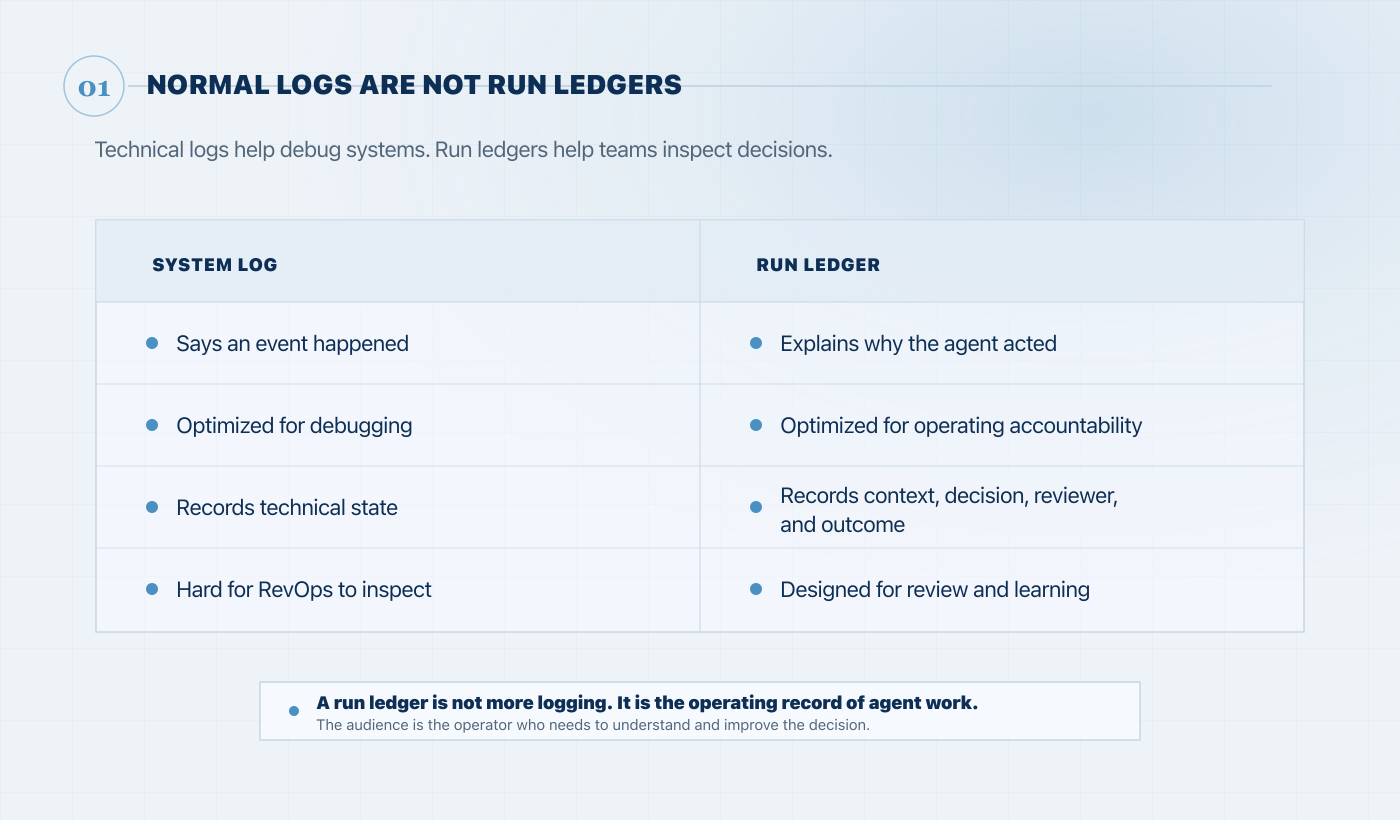
Most software already has logs. That does not mean the work is auditable in an operating sense.
A technical log may tell you that a job ran at 8:03, touched an account, returned a response, or wrote to a field. That helps when a system breaks. It does not necessarily help when a RevOps lead asks whether the agent made the right call.
Agentic GTM work needs a different kind of record.
It needs to preserve the context behind the action, the reason the action was allowed, the reviewer or owner involved, and the outcome that should teach the system what to do next.
What a run ledger has to capture
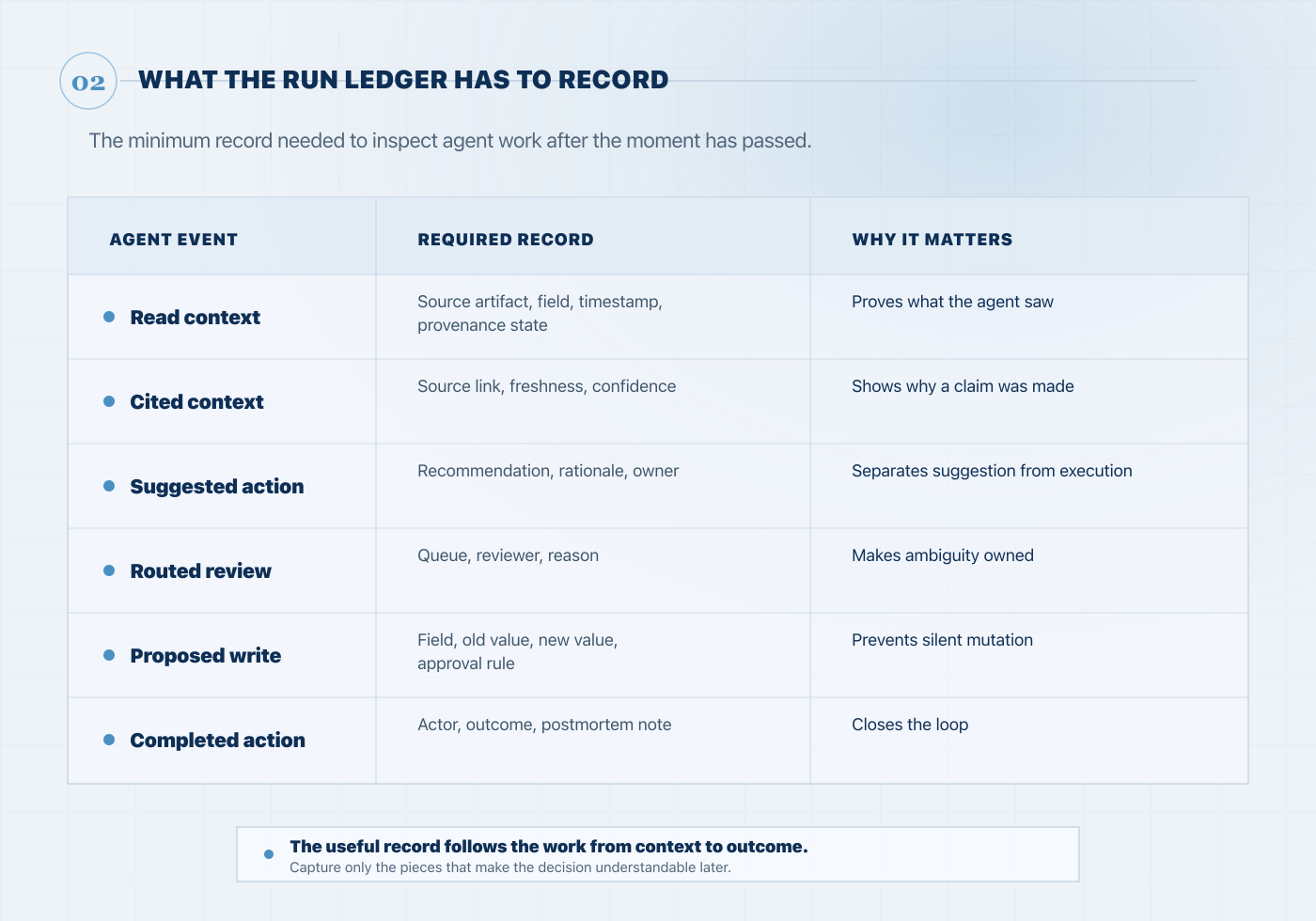
The ledger should follow the work from context to outcome.
If the agent reads a warehouse-derived account score, the ledger should know which source artifact it read. If the agent cites that score in a recommendation, the ledger should know why it considered the score usable. If the agent routes the account to review, the ledger should know who owns the decision. If a write is proposed, the ledger should preserve the old value, the new value, and the approval rule.
The point is not to create surveillance theater. The point is to make agentic work inspectable after the moment has passed.
The account prioritization problem
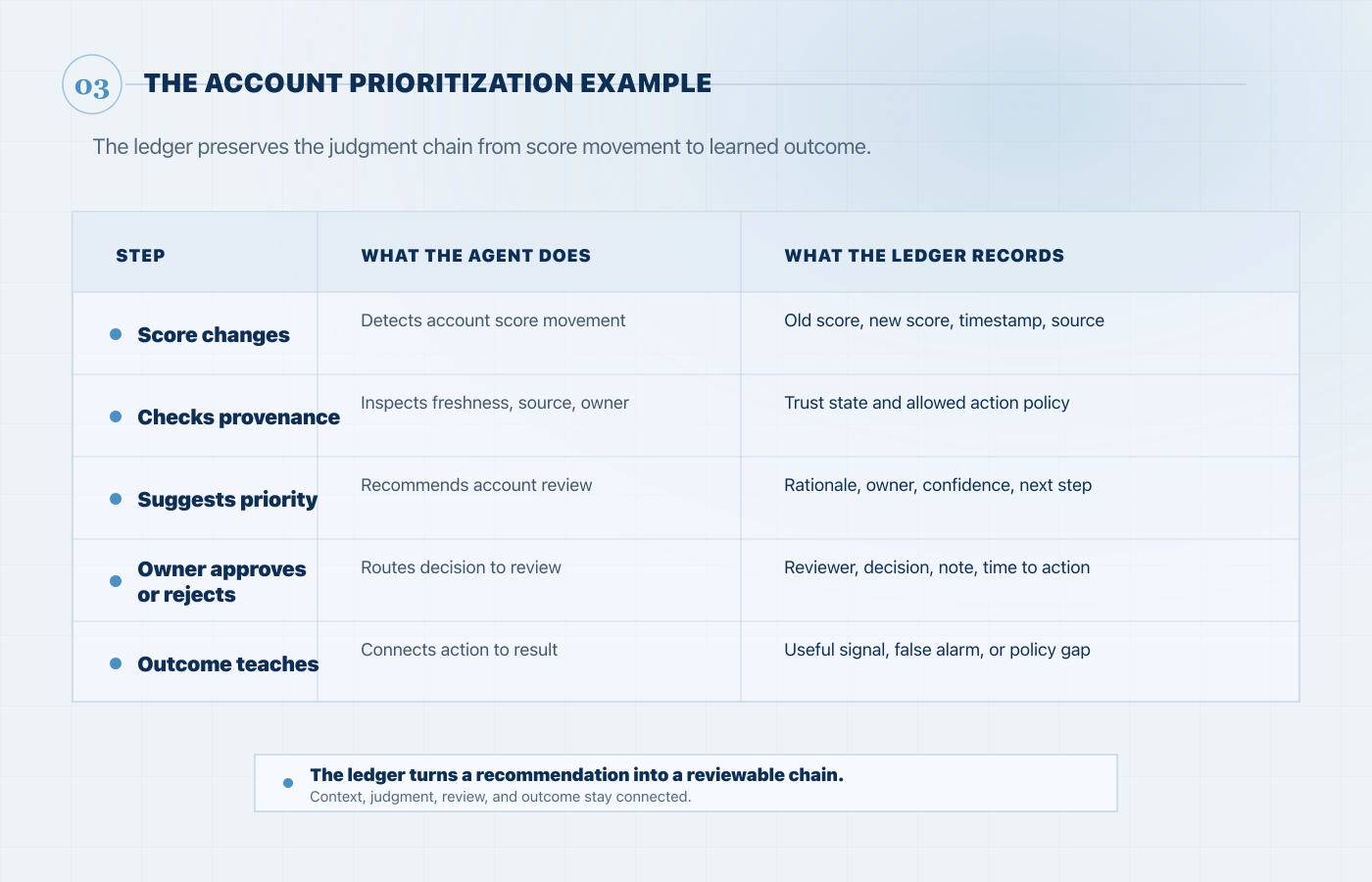
Account prioritization is a good place to see the difference.
An agent sees that an account score moved. It checks the provenance behind the score. It decides the signal is fresh enough to suggest a priority change, but not strong enough to update the CRM without review.
A normal automation log might record the run. A run ledger records the judgment chain.
The reviewer can see which score moved, what provenance supported it, what the agent suggested, who approved or rejected the motion, and what happened after the team acted.
That last piece matters. Without the outcome, the system learns nothing. It can keep creating the same kind of work whether or not the work ever changed a decision.
Why this matters for RevOps
RevOps is going to inherit the operating surface for a lot of agentic GTM work.
Not because RevOps should approve every action. That would collapse the leverage of agents. RevOps matters because it owns many of the fields, policies, handoffs, and review paths that decide whether an agent action is safe.
The run ledger gives RevOps a way to inspect the system without chasing screenshots, Slack threads, workflow logs, and CRM history one by one.
It also creates the feedback loop the system needs. Which signals became useful work? Which recommendations were ignored? Which review paths were too slow? Which fields kept creating ambiguity?
Those answers should not live only in people's heads.
What to build first
Start with the motions where agents already create or recommend GTM work: account prioritization, lead routing, renewal risk, deal inspection, outbound research, and CRM hygiene.
For each motion, record the same five things: the context the agent used, the judgment it made, the policy that allowed or blocked it, the human review outcome, and the business result after the work moved.
Keep the first version narrow. A ledger that captures a few high-impact decisions cleanly is more useful than a giant event dump no one reads.
The goal is not to preserve everything. The goal is to preserve the parts of the run that make the decision understandable later.
Where this goes next
Provenance makes context trustworthy. The review queue makes ambiguous work owned. The run ledger makes the decision traceable after the work moves.
The next layer is cadence.
Once the business can see what agents found, what humans approved, what changed, and what outcomes followed, the system can become part of the operating rhythm instead of another background automation.
Agentic GTM does not become operational when software can act. It becomes operational when the business can inspect, correct, and learn from the action.