

The conversation around AI in go-to-market strategy keeps obsessing over the wrong side of the ledger. Everywhere I look, the focus is production capacity: how many accounts an agent can research, how many emails a tool can draft, how fast enrichment can run, how many CRM fields can be cleaned, and how much of the follow-up motion can be automated.
I look at that and see an execution trap.
Generating a spike in raw GTM output is easy now. A small team can create more pipeline motion in an afternoon than an entire department used to produce manually in a quarter. But a louder motion does not mean the GTM system is getting stronger. Account research aimed at the wrong market just gives the team sharper notes on accounts that will not buy. Outbound to buyers without urgency creates polite noise. Enrichment without field trust fills the CRM with data people work around. Meetings with weak qualification make the dashboard look healthier than the revenue motion actually is.
AI expands the surface area of GTM activity. Architecture decides what actually converts.
The real leverage of AI is not the ability to produce a million cheap actions. It comes from an internal system that translates those actions into customer trust, sharper discovery, cleaner qualification, champion movement, and realistic revenue timing.
Moving Past The One-Model Stack
The first wave of AI GTM thinking was too simple: pick the best model, plug it into an outbound workflow, and point it at the market.
That works as a demo. It breaks as an operating model.
Treating every lead-generation task as a premium reasoning job turns into capital burn. Sales truth cannot come from every AI-produced signal. The system has to split the work.
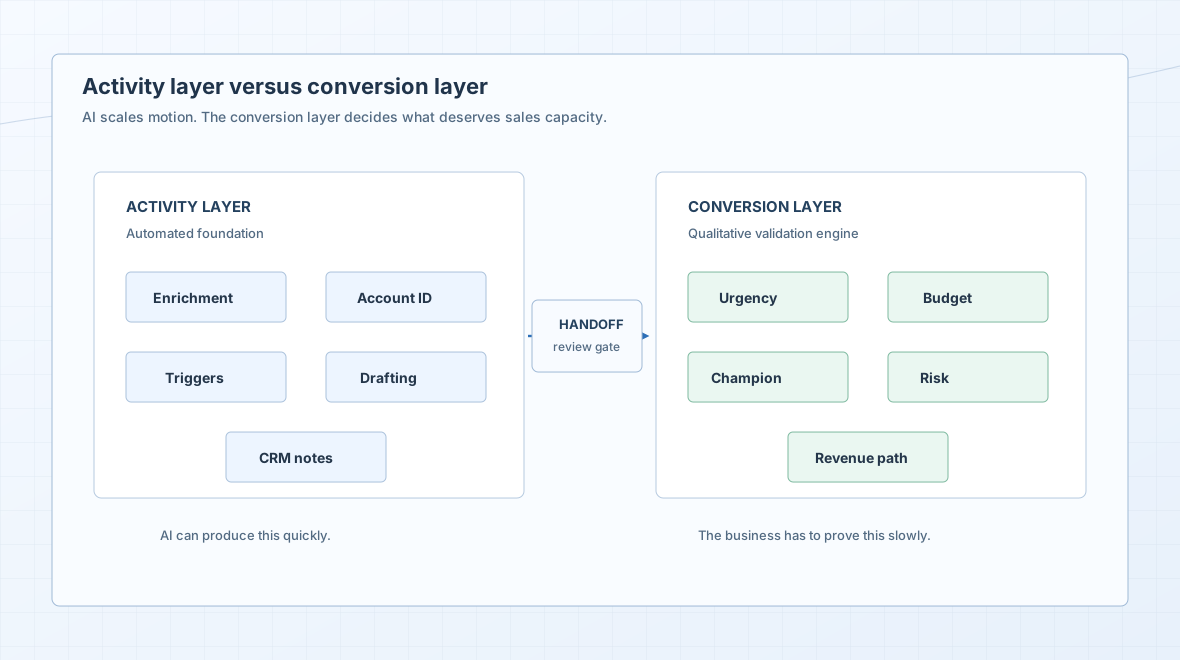
I think about the split in two distinct operational layers: the activity layer and the conversion layer.
The activity layer serves as the automated foundation. It handles the programmatic mechanics required to identify accounts, monitor intent signals, run background research, map organizational charts, and draft initial touches. This is where AI excels because it processes massive data pools at a near-zero marginal cost.
The conversion layer is where the business case lives. This layer acts as the qualitative validation engine, verifying political risk, workflow pain, implementation friction, buyer willingness to change, and true budget ownership.
An AI model can write a clean email from public company context. Internal urgency still has to come from the buyer. Org-chart mapping can find every VP in a target account, but political capital only shows up through the sales process. Weak GTM systems get exposed because they automate the first layer and assume the second layer will take care of itself.
Data Liquidity Matters
The conversion layer needs a technical foundation. I think about that foundation as data liquidity: how cleanly raw signals move through the GTM system without polluting the CRM or confusing the sales team.
The stack does not need to be exotic. A flexible database like Supabase can hold raw intent signals, scrape outputs, product usage events, and research artifacts before they touch the system of record. Workflow engines like n8n can route those signals through enrichment, classification, model calls, and review rules. HubSpot or another CRM can remain the destination for validated contacts, account updates, deal movement, and rep-facing alerts.
That structure matters because the CRM should not become the dumping ground for every AI guess. It should receive records that have cleared an operating threshold.
A cleaner workflow looks entirely different. An intent spike lands in the database. From there, the orchestration layer checks fit, enriches the account, asks a model for context, scores the signal, and sends only the validated action into the CRM. The AE sees a useful alert, not a pile of AI-generated noise. That is the difference between more automation and a system that can actually route sales attention.
The Myth Of Autonomous Interpretation
The biggest mistake I see companies making is trusting AI agents to interpret their own results. An outbound agent like Artisan's Ava or an enrichment pass running through Claygent can inspect a website, infer a tech stack, read job posts, and call a lead highly qualified. That is administrative inference. It is not commercial truth.
AI interpretation runs on visible information. A flat tone on a discovery call rarely shows up in the data. Department reorgs hide inside hesitation and vague timing. Polite curiosity in a demo can still sit three steps away from budget, security, procurement, and internal priority.
This is why the human layer remains the control plane. Agents clear the operational field and surface better context. Sales teams still own the qualitative work: earning trust, finding the true champion, exposing the hidden blocker, and deciding which deal deserves the next hour of capacity.
Making Discovery Compound
Customer discovery should not be treated as a scattered sequence of calls. It has to become a compounding mechanism. Every interaction with the market should make the next account selection sharper. A real discovery system teaches the company which segment has urgency, which pain has budget, which user feels the workflow problem first, which title can carry the issue internally, and which buying path can create revenue soon enough.
Weak systems drop that learning. Notes sit unread in the CRM, targeting stays static, outbound repeats the same assumption, and the next sequence starts from the same shallow premise. AI makes that failure more expensive because it accelerates the repetition.
A resilient GTM architecture feeds human discovery back into the targeting logic. Over time, the system narrows the conversion filter. Better account selection comes from the last conversation teaching the company something specific. The company is not just doing more; it is learning faster without letting the sales team absorb every unvalidated signal.
The Architect's Job
This is where the GTM architect role matters.
The job is not to recommend another AI tool or build another dashboard. It is to understand how the current system actually works: where leads enter, which fields people trust, which handoffs break, which KPIs change decisions, which automations create noise, and which parts of the funnel cannot convert more volume yet.
That means looking across CRM, marketing automation, integrations, reporting, territory design, compensation incentives, and the daily habits of the sales team. A conversion problem rarely lives in one tool. It usually lives in the space between tools, people, process, and incentives.
Salesforce, Marketo, HubSpot, enrichment tools, workflow engines, data warehouses, and AI agents all become useful only after the operating model is clear. The system needs to know which source owns the truth, which team owns the next action, which KPI points to revenue instead of motion, and which workflow deserves more pressure. A good dashboard does not just report activity; it helps leadership decide where to invest, where to slow down, where to disqualify faster, where territory coverage is wrong, and where the GTM motion is ready for more pipeline.
The Guardrails Are The Strategy
The practical work is less glamorous than the AI demo. Stage movement should not happen because an agent logged a meeting summary. Five surface-level fit signals do not make an account high priority. A confident paragraph from a workflow is not enough reason to spend the next sales hour on a lead.
The guardrail has to be stricter than that. Stage movement should require evidence: a real pain, a credible champion, an internal buying path, a timing reason, a business consequence, and a next step the buyer owns.
More pipeline may still be the right answer. I just want to know whether the current system can convert it first. The companies that win with AI in GTM will not be the ones generating the loudest automated motion. They will be the ones that can ingest that motion, filter out distractions, and convert valid signals into predictable revenue with the tightest operating footprint.